
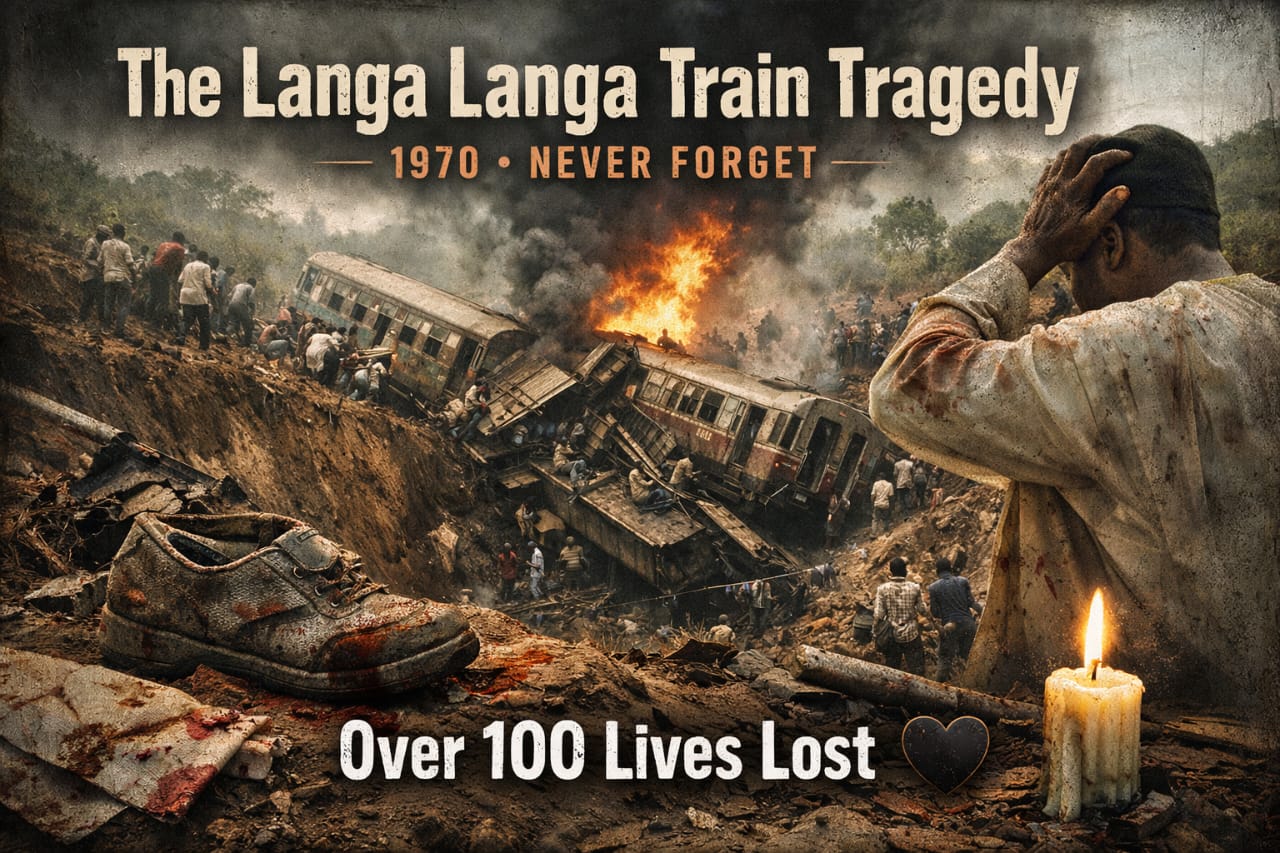

On 16th February 1970, along a stretch of railway in what is now Nasarawa State, a train journey ended in one of the most horrifying disasters in Nigeria’s history.
Near the village of Langa Langa, within the Akun Development Area of Akwanga Local Government Area, the railway line cut across land that most Nigerians would never think about. Scattered settlements stood at a distance from one another, and access was not easy. It was a place people passed through on their way elsewhere.
Not far from there lies Gudi, a small town along the Akwanga Keffi road, about nineteen kilometres away by rail. It was along this corridor, between these communities, that the disaster unfolded.
At that time, Nigeria was still trying to recover from the Nigerian Civil War. The war had ended only weeks earlier. Roads were damaged, movement was slow, and the railway system had become one of the few dependable ways to travel long distances. People relied on it because they had little choice.
On that day, the train carried more than passengers, it carried people trying to return to what they still remembered as a normal life.
Some were heading home after years of displacement and separation caused by the war. Some were traders moving goods. Others were families hoping to reunite. Among them were Muslims travelling ahead of Eid-el Kabir, hoping to arrive in time for prayer and celebration.
The train was crowded. Not unusually so for that time, but full enough that people stood where seats were not available, holding onto rails, sitting on luggage, adjusting themselves to the reality of travel in a country still recovering from war.
It was a journey like many others, until something went wrong.
Somewhere along that stretch near Langa Langa, the train lost control.
The exact cause was never firmly settled. Some spoke of brake failure. Others believed the tracks, weakened by years of neglect and war, could not withstand the strain. Whatever the cause, once control was lost, there was no easy way to regain it.
The train did not slow.
As it moved forward, the speed became dangerous. Then came the derailment.
The carriages did not simply leave the track, they tore away from it. One dragged another. Metal struck metal. The coaches did not fall neatly to the side, they crashed into a ditch beside the railway line. Some overturned into it, others were forced against one another, collapsing under their own weight.
That ditch made the entire situation several times worse than it would have ever been.
It made the wreck deeper, tighter, harder to reach. Carriages lay at angles that made access difficult. Some were partially buried against the earth, others pressed into one another so tightly that even seeing inside was a struggle.
Inside, passengers were thrown, crushed, or trapped.
There was a brief moment of stillness, then the noise returned. Cries for help, voices calling out names, the sound of people trying to move but unable to.
Then came the smoke.
Fuel leaked… And as expected in such circumstances… Fire followed.
Langa Langa was not a place with emergency services nearby. The first to respond were villagers, farmers, and travellers from nearby areas, including those coming from Gudi. They heard the crash and ran toward it.
They came without equipment. They came because people needed help.
What they met was a scene that would remain with them for the rest of their lives.
Carriages lay twisted inside the ditch and along the track. Some were on their sides. Others were crushed inward. The position of the train made rescue even harder. The depth of the ditch meant that reaching those inside required climbing down, balancing on unstable metal, and working in dangerous conditions.
There were no tools to cut through iron, no organised response, only hands and urgency.
People climbed down into the wreckage, pulling at doors, breaking windows, trying to create openings where none existed. Those who could move were pulled out first. Others remained trapped.
The fire was spreading. Everyone panicked more than ever as the reality became more and more undeniable. The passengers who were still alive watched in sheer horror as their lives flashed before their eyes. They had just escaped being completely crushed in the wreckage, and now they had to watch themselves slowly burn, agonisingly to death. It was as though that day, the Grim Reaper was just too desperate, too determined.
Time was no longer on anyone’s side.
Some victims were pinned so tightly that they could not be freed by pulling or lifting. Their limbs were trapped beneath heavy metal that would not shift. The ditch made it worse, because it limited space and made it harder to apply force.
In those moments, rescuers made decisions that no one should ever have to make.
Limbs were cut to free the living.
It was done there, beside the wreck, without proper instruments, without medical support, without anaesthesia; raw, fresh, excruciating, with only the aim of saving a life before the fire reached them. It was not a matter of procedure, it was a matter of time.
Some survived because of those actions.
Others could not be reached before the flames spread further. There are speculations that some rescuers who went down the ditch to save lives never came out again, they were trapped there forever, lost in the flames.
The fire consumed parts of the train. Smoke filled the air. In some sections, the cries stopped. In others, they continued until they could not.
By the time it was over, more than one hundred people had lost their lives.
Their bodies were brought out and laid beside the railway line. Survivors were carried away, many in shock, some severely injured, some without limbs. None of them left unchanged.
News of the disaster spread across the country. It struck a nation that was already grieving.
Nigeria had just come out of war, then this followed.
Fear spread quickly. The railway, once a necessity, became something many people avoided. The thought of travelling by train began to carry unease, some refused to use it again.
For those around Langa Langa and Gudi, this was not distant news.
★ It was a place they knew.
★ A stretch of railway they could point to.
★ A memory tied to the land itself.
Even years later, passing that area carried weight. People remembered what happened there. Some spoke of it in lowered voices, others chose not to speak of it at all.
Yet beyond statistics and infrastructure, what remains is the human story.
- The father who never reached his children.
- The mother who never arrived for the celebration.
- The travellers who set out with hope and never returned.
- The survivors who carried both their injuries and their memories for the rest of their lives.
These are the true legacy of that day.
More than five decades later, the Langa Langa train wreck remains one of Nigeria’s most painful transportation disasters. It reminds us how easily systems can fail, how quickly life can change, and how, even in the worst moments, people still try to save one another.
To remember this tragedy is to honour those who were lost and to recognise those who survived.
May the souls of the departed rest in peace.
May their memory remain in the conscience of the nation. 🖤🕯️
