

JudeEsq
















Lorem Ipsum has been the industry’s standard dummy text ever since the 1500s.
Many Nigerians enter into contracts every single day without realising it. Contracts are not limited to signed documents, lawyers’ offices, or stamped papers. Under Nigerian law, a contract can arise through spoken words, conduct, messages, and ordinary daily transactions.
Once you understand this reality, you protect yourself in two important ways. First, you reduce the risk of entering into obligations you never intended. Second, you become able to enforce your rights when agreements are broken.
What is a contract under Nigerian law?
A contract is a legally binding agreement between two or more parties which the law will enforce. Not every agreement qualifies as a contract, but every contract begins as an agreement. The difference lies in whether the agreement satisfies specific legal requirements.
Once those requirements exist together, the law treats the agreement as binding, whether or not the parties later regret their decision.
The essential elements of a valid contract
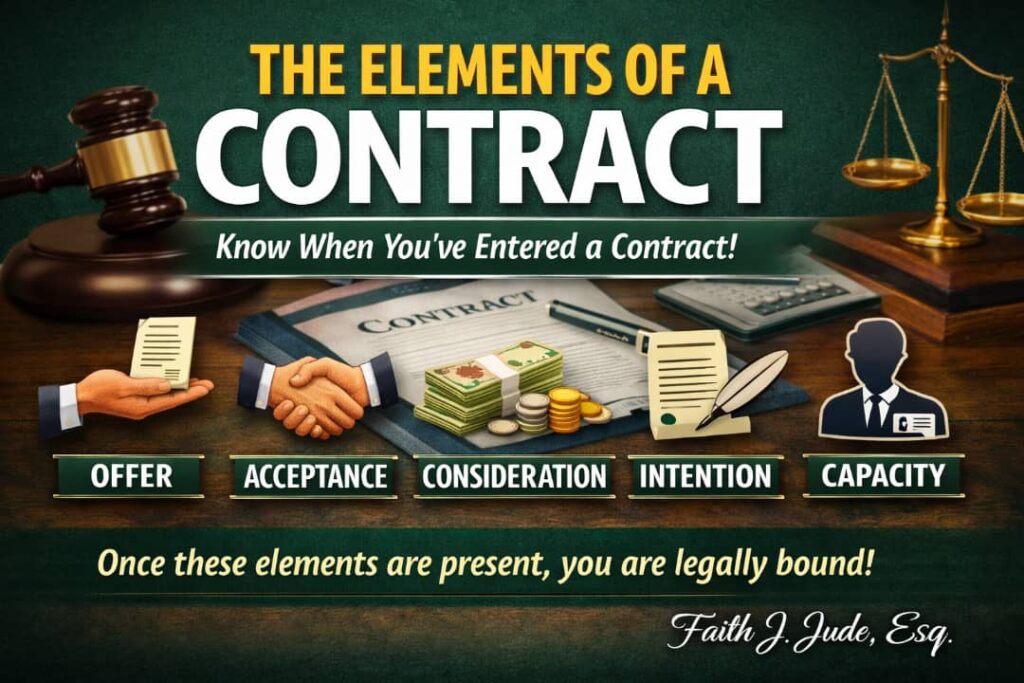
For a contract to exist under Nigerian law, five elements must be present. If even one is missing, the agreement may fail as a contract.
1. Offer
An offer is a clear and definite promise made by one party to do something, or to refrain from doing something, on specific terms, with the intention that it will become binding once accepted.
An offer must be precise. Statements of intention, invitations to negotiate, or casual discussions do not qualify as offers.
For example, advertising goods for sale is usually an invitation to treat, not an offer. However, once a person says, “I will sell this item to you for this price,” the law treats that statement as an offer.
What an offer looks like in real life
A landlord says, “I will rent this two bedroom flat to you for ₦800,000 per year, you will pay upfront.” That is an offer.
A vendor says, “I will supply you 500 bags of cement at ₦8,000 per bag, I will deliver next week.” That is an offer.
A freelancer says, “I will design your website for ₦200,000 and deliver in fourteen days.” That is an offer.
What is not an offer
Statements such as “I might sell my car,” “Let us talk about renting the house,” or “I am considering doing the job” are not offers. They are discussions or invitations to negotiate.
Warning
Once you clearly state terms and show seriousness, the law may treat it as an offer even if you later claim you were joking or speaking casually. Courts rely heavily on written evidence, especially WhatsApp chats and voice notes. Be careful what you promise.
2. Acceptance
Acceptance is a clear and unconditional agreement to the exact terms of the offer. It must match the offer precisely. If you introduce new terms, it is not acceptance. It becomes a counter offer.
Acceptance can be verbal, written, or inferred from conduct. Silence, by itself, does not amount to acceptance under Nigerian law. However, certain actions can amount to acceptance.
Examples of acceptance
If someone responds to the landlord offering the apartment at ₦800,000 per year by saying, “I agree. I will pay the ₦800,000 today,” that is acceptance.
If a customer sees the cement vendor’s offer and transfers money, that payment amounts to acceptance.
If a freelancer begins working on your website because you replied “okay,” the commencement of work can amount to acceptance, even if no payment has been made yet. If you did not mean approval, replying “okay” was a dangerous choice. Words matter.
What breaks acceptance
If someone says, “I agree, but reduce the price,” or “₦800,000 is too much, I will pay ₦650,000,” that is not acceptance. It is a counter offer.
Remaining silent and doing nothing is generally not acceptance in this type of situation.
Warning
Once acceptance occurs and the other elements exist, the contract is formed immediately. Saying later that you were still thinking does not cancel acceptance. Paying money, confirming by message, or starting performance can lock you in legally.
3. Consideration
Consideration is the value each party gives or promises to give. It answers a simple question, what is each person contributing to make this agreement work?
Consideration does not have to be money. It may be goods, services, time, effort, or even a promise to act or not to act.
Examples of consideration
Money paid for goods or services is consideration.
A promise to deliver goods in exchange for payment is consideration.
If someone says, “I do not have money, but I will give you three bunches of plantain,” and the other party agrees, that plantain is consideration. Whether the plantain is a good deal is irrelevant in law.
Agreeing to work for a salary is consideration.
Agreeing not to open a competing business can also be valid consideration.
Important legal truth
Nigerian courts do not assess whether a deal is fair. They only ask whether something of value was exchanged.
Warning
Saying “I was cheated” does not automatically cancel a contract. A bad bargain remains a bargain in law, unless fraud, coercion, or another legal defect is proven.
4. Intention to create legal relations
The parties must intend that their agreement will have legal consequences. In commercial and business transactions, Nigerian law presumes this intention automatically.
In social or family arrangements, intention is not presumed unless clearly shown. This is because many family and friendship arrangements are made to preserve harmony, not to create legal obligations.
How courts look at intention
Business deals, supply agreements, employment arrangements, and rental agreements are presumed to carry legal intention.
Casual promises between friends, such as “I will help you next week,” usually do not carry legal weight unless money or obligations are involved.
Once money enters a relationship, courts are far more likely to find legal intention.
Warning
Calling someone “my brother,” “my sister,” or “my friend” does not remove legal responsibility. If the arrangement looks commercial or involves money, the law usually presumes legal intention, regardless of personal relationship, subject to limited exceptions.
5. Capacity to contract
The parties must have legal capacity to enter a contract. Under Nigerian law, certain persons have limited or no capacity.
These include minors, persons of unsound mind at the time of contracting, and persons under legal restriction.
Examples of capacity issues
A contract with someone below eighteen years of age may not be enforceable except for necessities such as food or clothing.
A contract entered into by someone who was mentally incapable at the time may be voidable.
A company director acting outside the company’s authority may create enforceability problems.
Warning
Do not assume an agreement is enforceable simply because it was signed. Capacity matters.
At the same time, do not assume you can escape responsibility by later claiming incapacity without strong proof. Courts demand convincing evidence.
For example, claiming you were drunk when you signed an agreement is not enough. You must show that your level of intoxication was so severe that you could not understand what was happening.
If you still entered a bus, went home alone, stopped at your junction, bought bole, and used your Opay with the correct pin, proving total incapacity will be very difficult. Abi you wan whine my lord? 🌚
When exactly do you enter into a contract?
You enter into a contract the moment all five elements exist together. There is no requirement for a written document unless the law specifically demands one, such as contracts involving land.
A WhatsApp message can form a contract. Be careful what you say there.
A verbal agreement can form a contract. Many people speak carelessly, assuming everything is a joke, without realising the other party may take them seriously and act based on those words.
Payment followed by performance can also form a contract.
What matters in Nigerian contract law is substance, not formality.
Once offer, acceptance, consideration, intention, and capacity are present, you are legally bound. If you later decide you do not want to continue, that is breach of contract, and the other party may sue.
Common misconceptions Nigerians have about contracts
Many people believe that without a signed document, there is no contract. That belief is false.
Some believe that saying “I did not mean it seriously” cancels an agreement. That is also false where intention is inferred from conduct and surrounding circumstances.
Others believe contracts only exist when lawyers are involved. Nigerian law does not support that view.
Why this knowledge matters
Contracts define rights, obligations, and remedies. If you do not understand when you have entered a contract, you may breach one without knowing. If you do not understand what makes a contract valid, you may fail to enforce one that protects you.
Nigerian law treats contracts as instruments of certainty. Once the legal elements are present, the law steps in, regardless of changing emotions.
This is not about fear. It is about awareness. It is about knowing the exact moment the law begins to hold you accountable.
That understanding is the foundation every Nigerian should have.