

JudeEsq
















Lorem Ipsum has been the industry’s standard dummy text ever since the 1500s.
What Is the New Tax Law in Nigeria?
The changes came from several bills that were signed into law and combined many old tax laws into one easy-to-understand system. This new system replaces laws like the Companies Income Tax Act, Personal Income Tax Act, Value Added Tax Act, Capital Gains Tax Act and others.
The federal tax agency, formerly called the Federal Inland Revenue Service, is now renamed the Nigeria Revenue Service.
1. Who Starts Paying What and How Much
Personal Income Tax (Tax on Workers):
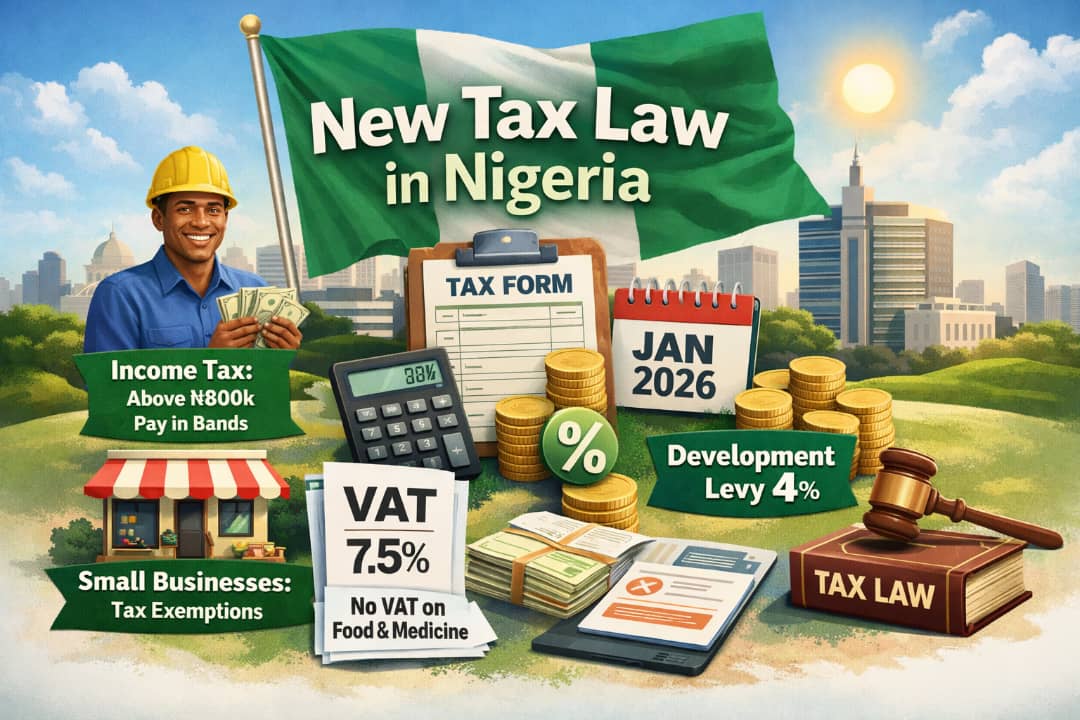
If you earn 800,000 naira or less per year, you pay no personal income tax at all.
If you earn more than 800,000 naira per year, the tax rate goes up in steps or bands, so those who earn more pay higher percentages.
Here are the income tax bands in simple form:
- ₦0 to ₦800,000 per year = 0% tax
- ₦800,001 to ₦3,000,000 = 15%
- ₦3,000,001 to ₦12,000,000 = 18%
- ₦12,000,001 to ₦25,000,000 = 21%
- ₦25,000,001 to ₦50,000,000 = 23%
- Above ₦50,000,000 = 25%
This means most Nigerians pay less tax than before because incomes below 800,000 naira are fully exempt and the tax brackets are structured to ease tax burden on low and middle income earners.
2. VAT (Value Added Tax)
The standard VAT rate remains 7.5 percent, not increased as earlier rumours suggested.
Many everyday essential goods and services are now zero rated or exempt from VAT, meaning businesses do not charge VAT on them. These include:
a) Basic food items
b) Medicine and medical supplies
c) Educational books and materials
d) Transport services like shared roads and buses
This will reduce the cost of living for ordinary families if businesses pass the savings to consumers.
3. Small Business and Company Tax Changes
A. Small Businesses
Small companies with turnover up to ₦100 million and total fixed assets up to ₦250 million are now exempt from Company Income Tax, Capital Gains Tax and the new Development Levy.
This change was made so small businesses can grow without heavy taxes.
B. Larger Companies
Big companies and multinationals may now face a minimum effective tax rate of 15% if they are part of a very large global group.
C. New Development Levy
Instead of many small levies like education tax and police trust fund levy, there is now a single 4% development levy on assessable profits for medium and large businesses.
4. Personal Reliefs and Deductions
Rent Relief
Under the new law, you can claim rent relief where part of the rent you pay is deducted from your taxable income. There is a cap, so it is not unlimited, but this helps reduce tax for those who qualify for this.
Mandatory Filing
Every taxpayer, including workers and companies, must file a tax return each year even if no tax is owed.
5. Penalties and Enforcement
The new tax laws also include stronger penalties for not complying, such as:
a) Penalties for failing to register for tax or file returns on time
b) Higher fines for inaccurate or late filing
c) A system that ties interest and penalties to the Central Bank of Nigeria monetary policy rate so that late payments are expensive
Tax authorities also have new powers to share data across government agencies to reduce tax evasion and ensure fairness.
6. Digital Tax Compliance
The new tax laws require businesses to use electronic invoicing and digital systems. This means every VAT transaction must be recorded electronically in real time. This digital system helps with transparency, reduces fraud, and speeds up compliance.
Why These Changes Matter
These reforms are meant to make the tax system easier to understand, more fair, and better at raising money for public services like roads, schools and hospitals. Many low and middle income earners will benefit from lower tax rates and exemptions. The system also modernises tax collection using digital tools which may reduce cheating and delay.
The government says that these reforms do not add arbitrary new taxes but rather reorganise how taxes are collected and ensure the system is fair and competitive.
When the New Laws Started
All the new tax laws officially started on 1 January 2026.
Let’s Quickly Summarise
- Nigeria changed major tax laws and the new system started from January 1 2026.
- Most workers earning ₦800,000 or less per year now pay no income tax.
- Richer workers pay tax in clearer bands up to 25%.
- VAT stays at 7.5 percent and essentials like food and medicine are not taxed.
- Small businesses get big tax breaks.
- Many smaller levies are replaced with a single 4% development levy for bigger companies.
- Everyone who earns must file a tax return each year.
- Digital tax systems and tougher penalties are now in force.
Written by Faith J. Jude, Esq
www.jude.ng