

JudeEsq


























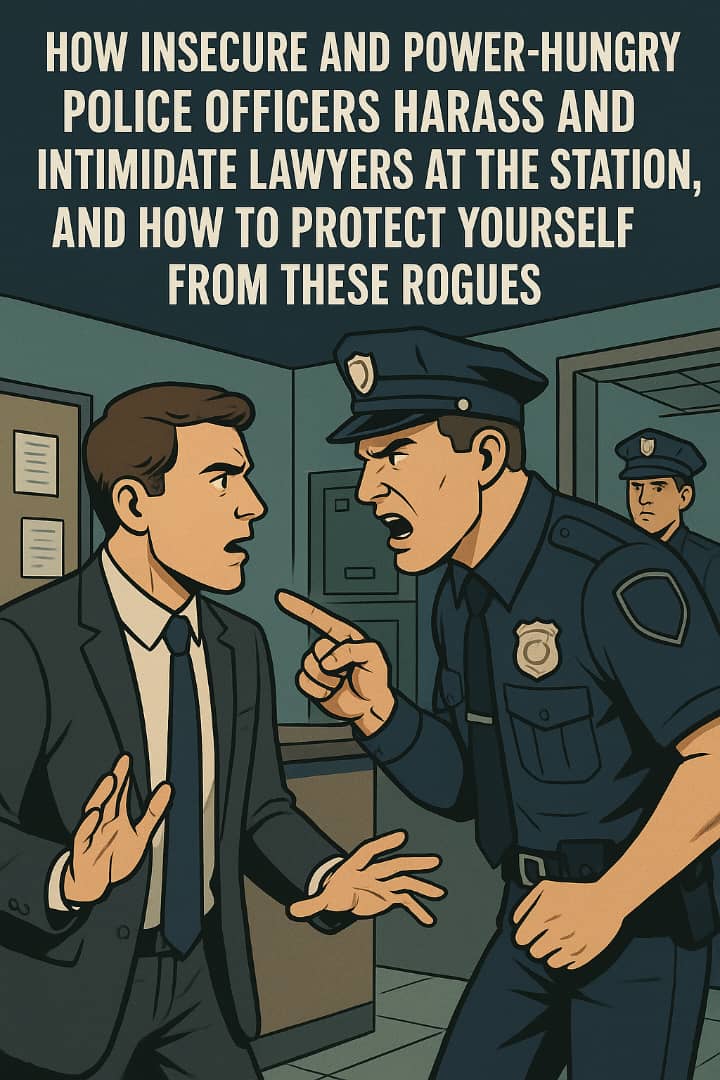
I write this as a practising lawyer in Nigeria who has spent many hours in police stations late into the night. I have seen colleagues insulted, pushed about, denied access to clients, and in a few tragic cases physically assaulted. I have also seen how a calm, prepared, legally confident lawyer can change the mood of a room and turn hostility into cautious cooperation.
If you are a lawyer who has wondered whether the way officers treat you is merely about your personality or whether it is an institutional problem, this piece is for you. I explain, plainly and precisely, what police harassment looks like, why it happens, what the law says, what rights lawyers and suspects enjoy, and step by step what to do before, during and after any police contact to protect yourself, to protect your client, and to earn reverence rather than rancour in that room.
Because this is about survival and about professional dignity, I have grounded every legal point in primary sources and recognised institutions. Where I cite law or policy I give the source so you can read it yourself.
Table of contents
1. What is police harassment in the context of lawyers and why it happens
2. The legal landscape lawyers must know at the station and in court
3. Practical preparations before you visit the station
4. What to do the moment you enter the station or encounter an outrageous officer
5. Documenting everything and preserving evidence
6. Handling threats, physical assault or unlawful detention of your client or yourself
7. When to invoke habeas corpus and other immediate remedies
8. Complaints, disciplinary routes and seeking redress after the event
9. How to build long term reverence and safer working relationships with police
10. Final checklist and short model wording you can use at the station
1. What is police harassment in the context of lawyers and why it happens
Police harassment of lawyers takes different forms. It can be refusal to allow you consult your client. It can be insulting or intimidating language. It can be arbitrary arrest or detention of the lawyer or the client. It can be threats, physical assault, seizure of documents or destruction of property. It can also be deliberate delay in producing a client to court, or inventing new charges to keep someone in custody. These actions are not mere personality conflicts. They are usually core manifestations of three things.
First is power dynamics. Police officers on duty control access to liberty, records and evidence. Some officers enjoy showing that power. They may want to assert dominance over a lawyer because they believe the lawyer is an irritant or a threat to investigations.
Second is fear of exposure. A lawyer who is effective may threaten corrupt or sloppy investigations. Instead of improving conduct, some officers respond with hostility toward the messenger.
Third is institutional weakness. Training on rights of arrested persons and the proper relationship between police and counsel is uneven across the force. Where supervision is weak and internal discipline is poor, misconduct rises. The Police Code of Conduct and revised use of force manuals require professionalism and minimal force, but practice sometimes lags behind policy. See the Nigeria Police Code of Conduct and the NPF revised use of force guidance.
2. The legal landscape lawyers must know at the station and in court
You must know the law so you do not accept improvised rules. The big principles you must never forget are these.
Right to personal dignity. The Constitution forbids torture and inhuman or degrading treatment. That protection applies to lawyers and suspects alike. See Section 34 of the Constitution.
Right to personal liberty and legal consultation. Section 35 of the Constitution guarantees personal liberty and specifically states that a detained person has the right to consult a legal practitioner of his or her choice and to remain silent until after consultation. The detained person must also be informed in writing within 24 hours of the facts and grounds of arrest. These are non negotiable rights that police must respect.
Police powers and limits. The Police Act 2020 sets out modernised powers of arrest, search and procedure. The Act also removed some older provisions that permitted arrest in place of a suspect. The new Act describes when and how arrests may be made and how detainees are to be handled. Know the relevant provisions so you can call officers to order by citing the statute if necessary.
Professional standards for police conduct. The Nigeria Police Force has a code of conduct and a revised use of force manual that demand restraint and professional behaviour. Those policy instruments are not toothless. They are grounds for internal complaint and for public accountability processes such as the Police Public Complaints Committee and the National Human Rights Commission. Use them.
Bar association support and public pressure. The Nigerian Bar Association regularly condemns unlawful arrests and harassment of lawyers and can bring collective pressure, litigation and media scrutiny to bear. In serious incidents contact your branch of the NBA immediately. Recent NBA statements confirm that the association takes such complaints seriously.
3. Practical preparations before you visit the station
Carry your practising certificate and photographic identity. Present them right away. If the officer insists on seeing more identification, politely ask which law gives the power to detain you for lack of a document. The practising certificate should afford immediate recognition.
Bring a client authorisation letter. Ask your client to give a short written instruction naming you as counsel to act on their behalf. That letter reduces frontal disputes. It is not always conclusive, but it removes the patina of improvisation.
Note the station details on your phone. Record the officers present on arrival by name, rank and station diary number where possible. Request the station diary entry for the arrest or reporting incident. The station diary is a public official document and the station is obliged to produce it on request.
Carry a small lawyer kit. Paper, pen, copies of the Criminal Procedure Code or applicable ACJA provisions, and the Bar contact of a senior colleague. Have the National Human Rights Commission and Police Public Complaints Committee numbers saved. When things go wrong you will need quick contacts. See NHRC and PPCC details.
Be mentally prepared and dress appropriately. Professional composure matters. You will be taken more seriously if you are calm, direct and visibly in control. Avoid loud arguing. You may be pestered for your mood. Your calm is your first legal weapon.
4. What to do the moment you enter the station or encounter an outrageous officer
Do not moralise. Be procedural.
State your identity and that you are the counsel for the detained person. Request to see the client immediately and to be allowed to consult in private. Cite Section 35 and demand the written notice of arrest within 24 hours. Ask for the station diary entry number and request that your attendance be recorded. If the officer refuses, record the refusal on your phone with time stamp and your short note of the officer present.
If the officer insults or threatens you, remain silent or speak only to ask for the superior officer. Say this in a neutral tone. Where possible audio or video record the encounter. Recording laws are not absolute but courts accept audio visual evidence of official misconduct where it was lawfully acquired in the course of public duty. If you cannot record, ask a colleague or a witness to sign a contemporaneous statement.
If an officer refuses you access to your client, call the officer in charge of the station. If that officer refuses, demand the duty officer on call by name or rank. If there is no response phone your senior counsel or the NBA emergency line for advice and to alert them that you are being obstructed. Keep the call short and factual.
Where your client is being denied basic rights such as food, medical attention, or access to counsel, and the police insist on unlawful behaviour, inform them that you will file an urgent fundamental rights enforcement application or a writ of habeas corpus. Do not threaten unless you mean it. Your mention of legal remedies is often enough to get movement. Courts have consistently protected access to lawyers and habeas corpus is an immediate remedy for unlawful detention.
5. Documenting everything and preserving evidence
Every second in the station is evidence. Do not lose it.
Ask for and obtain the station diary entry. Photograph it. Ask for a copy. If your request is refused that refusal is itself evidence. Record it.
Make contemporaneous notes of the names and ranks of officers, times of key events, what was said and who was present. These notes may be vital later.
If there is physical contact, immediately seek medical attention and obtain a medical report from a hospital. Take photographs of injuries. Medical reports are powerful evidence in any complaint or suit for assault.
Save all digital logs. Keep copies of phone calls, WhatsApp messages, voice notes and any digital proof that shows who said what and at what time. If your phone is seized, loudly state your objection and demand written authority for seizure. Log the names of the officers who seized your device and insist on a receipt.
6. Handling threats, physical assault or unlawful detention of your client or yourself
If you or your client are assaulted, drive or walk immediately to the nearest hospital and obtain a medical report. Then return and report the assault in writing. Ask to see the officer in charge and record his or her response. Then notify the NBA and NHRC and lodge a formal complaint with the Police Public Complaints Committee. File a criminal complaint for assault or attempted assault. The Public Complaints Commission and NHRC can investigate administrative and human rights breaches.
If you are arrested without lawful basis, demand to be charged or released. The Constitution requires prompt production before a judicial officer and the right to legal consult. If these rights are violated apply for habeas corpus immediately. The courts have repeatedly affirmed that unlawful detention can and should be challenged without delay.
If your documents or phones are seized unlawfully, you can make an application for an interim injunction to prevent destruction of evidence and apply for restitution. File a complaint against the seizing officers with the station and escalate to the force CID and the Police Public Complaints Committee.
7. When to invoke habeas corpus and other immediate remedies
Habeas corpus is the fastest constitutional tool you have to secure release of a client held unlawfully. It is the proper remedy when a person is detained without lawful authority or when the reasons for detention are not disclosed. The writ orders production of the body and inquiry into legality of the detention. See legal commentary on habeas corpus and the constitutional provisions that allow it. Apply immediately at the Federal High Court, the State High Court, or any court with jurisdiction in the area.
If the client is charged and you need urgent access for preparation, the court may order production and give directions for bail. Use the court process to compel the police to make disclosure. The Administration of Criminal Justice Act contains provisions on disclosure and timely arraignment that can be used to pressure the police to act within the law.
8. Complaints, disciplinary routes and seeking redress after the event
If the officer has acted in breach of law or policy you have several overlapping options.
Internal police complaint. Lodge a formal complaint at the station and obtain a receipt. Then escalate to the Police Public Complaints Committee which exists to handle public complaints and to recommend discipline. The PPCC is not powerless. It can recommend prosecution or administrative action.
Human rights complaint. File a complaint with the National Human Rights Commission. The Commission can investigate and may seek redress, compensation or refer the matter for prosecution.
Public Complaints Commission. This federal commission accepts complaints against public officers and can investigate administrative wrongs.
Bar action. Notify your local or national branch of the Nigerian Bar Association. The NBA has taken collective action in the past to protect members, and public pressure from the Bar can prompt internal police discipline. See recent NBA statements condemning harassment of lawyers.
Civil suit and criminal prosecution. If you or your client were assaulted or unlawfully detained, you can pursue civil claims for trespass to person, false imprisonment and claims for exemplary and aggravated damages. Where appropriate, seek criminal prosecution of offending officers.
9. How to build long term reverence and safer working relationships with police
Your goal as a lawyer is to be respected, not feared. Respect is earned through competence and consistent professional conduct. These practical tips help.
Know the law cold. When you quote the Constitution, the Police Act and the Criminal Procedure Code with precision the officer knows you are not bluffing.
Be courteous and calm. Even when the other side is loud. Your calmness signals control.
Avoid gratuitous social media attacks. Public shaming is sometimes necessary but a measured notice to the station followed by legal action is usually more effective. Overuse of public shaming can antagonise those you need to cooperate with.
Train junior lawyers. Teach young colleagues how to record a station diary, how to request a JD or a production order, and how to file an immediate habeas corpus application. Collective education reduces ad hoc mistakes.
Build relationships with human rights officers and the NBA. The Bar can step in to mediate and to escalate when necessary. When the Bar is ready to litigate, police supervision pays attention.
Exercise restraint in the language you use. Call officers by rank and name. Request, do not order, unless the law requires you to order. When you must be forceful, be precise and move to court without delay.
10. Final checklist and short model wording you can use at the station
Before you go to the station
• Carry your practising certificate and ID.
• Save NHRC and PPCC emergency numbers.
• Have a client authorisation letter.
• Keep a senior lawyer on speed dial.
On arrival at the station
• Present NBA ID and your annual practising certificate for that year.
• Politely state that you are counsel to the detained person and request private consultation pursuant to Section 35 of the Constitution. Cite Section 35 aloud.
• Ask for the station diary entry and copy it or photograph it.
If you are obstructed
• Remain calm, say you will report the obstruction to the officer in charge and the Bar.
• Record the refusal and names of officers.
• Invoke habeas corpus if detention is unlawful.
Model short statement you can read into your phone and later present in court or in complaint letters
My name is [name]. I am a legal practitioner and I am here for my client [client name]. I request immediate private consultation and I request that the station diary reflect my attendance. I remind the officers that Section 35 of the Constitution guarantees the detained person the right to consult a legal practitioner and to be informed in writing of the reasons for arrest. If access is denied I will take all necessary steps including petition to the court and complaint to the Police Public Complaints Committee. This statement is contemporaneous and I request that it be noted.
Police harassment against lawyers is a serious problem. It is not always about low self esteem. It may be about the officer trying to show power, about institutional defects, or about fear of exposure. But you are not helpless. The Constitution, the Police Act, the Police Code of Conduct, and public institutions such as the Police Public Complaints Committee, the National Human Rights Commission and the Nigerian Bar Association give you tools.
Preparation, calmness, documentation and knowledge of the law convert vulnerability into authority. Use the remedies available to you promptly. Where necessary, escalate to court with habeas corpus and enforcement applications. Where misconduct occurs, use the complaint mechanisms and be prepared to litigate for damages.