

JudeEsq

























Moving in terms and Moving properly
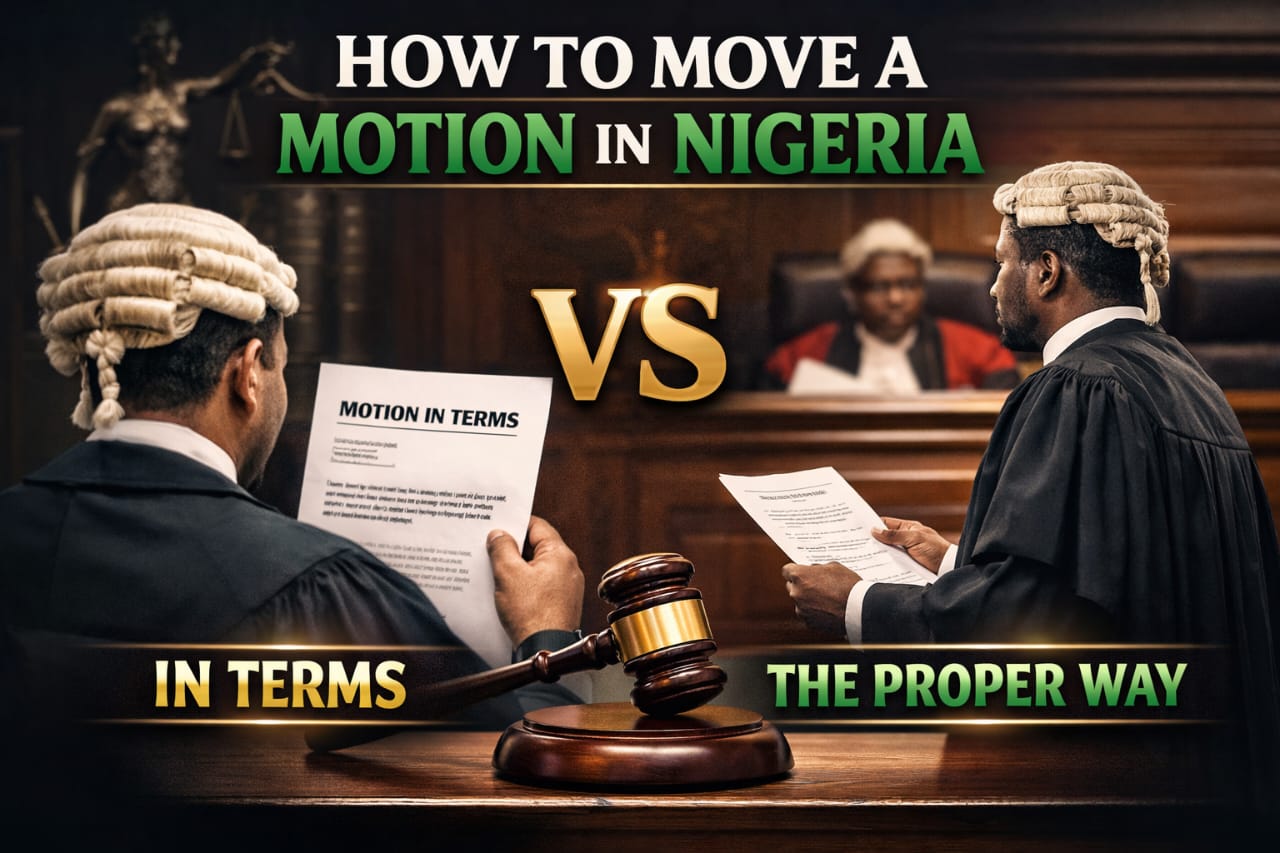
This guide explains the two distinct methods of moving a motion in Nigerian courts, the difference between them, and how to respond instantly to the court.
Courts such as the Federal High Court and State High Courts regularly require counsel to switch between both methods without warning, any lawyer who does not understand the distinction risks immediate correction in open court.
THE FUNDAMENTAL DISTINCTION
There are two different ways to move a motion:
1. Moving a motion in terms of the face of the motion paper
2. Moving a motion properly
They are not the same.
- Moving in terms is a formal request without explanation
- Moving properly is a structured presentation of the application
A lawyer must know both and switch instantly depending on what the court directs.
PART ONE
HOW TO MOVE A MOTION IN TERMS
This is the short form of moving a motion.
You are not arguing, you are not explaining, you are not taking the court through the processes, you are simply placing the application before the court.
It is used where:
- The motion is unopposed
- The court has read the processes
- The judge wants speed
- The court specifically says, “Move your motion in terms”
STANDARD FORM
When your case is called and you have announced appearance, you say:
“My Lord, we have a motion dated the ___ day of ___ 20__, and filed on the ___ day of ___ 20__. We respectfully move the motion in terms of the face of the motion paper and urge this Honourable Court to grant the reliefs sought.”
That is complete.
WHERE THE COURT REQUIRES MORE FORMALITY
You may add:
“My Lord, the application is brought pursuant to the provisions endorsed on the motion paper, supported by an affidavit and a written address already before the court. We adopt same and urge the court to grant the application.”
You must still remain brief.
IMPORTANT RULE
When moving in terms:
- Do not cite laws
- Do not summarise facts
- Do not argue
- Do not read your written address
Anything beyond the basic form becomes unnecessary argument.
PART TWO
WHERE YOU SEEK LEAVE TO MOVE IN TERMS
In some courts, especially where proceedings are tightly controlled, counsel may be required to seek leave before moving in terms.
STEP 1. SEEK LEAVE OF COURT
After your case is called and you announce appearance, you say:
“My Lord, we have a motion dated the ___ day of ___ 20__, and filed on the ___ day of ___ 20__. We respectfully seek the leave of this Honourable Court to move the motion in terms of the face of the motion paper.”
Then stop speaking.
Wait for the court.
STEP 2. IF LEAVE IS GRANTED
Once the court says “Leave granted” or “You may proceed”, you immediately move the motion:
“Much obliged, My Lord. We move the motion in terms of the face of the motion paper and humbly urge this Honourable Court to grant the reliefs sought.”
That is sufficient.
Do not add anything unless the court asks.
IF THE COURT ASKS WHY YOU ARE SEEKING LEAVE
Answer briefly, without argument:
“My Lord, the motion is unopposed and the processes are regular before the court.”
or
“My Lord, the Respondent has been duly served and there is no counter affidavit.”
Do not argue the motion.
IF THE COURT REFUSES LEAVE
If the court says:
- “Move your motion normally”
- “Proceed to move your motion”
You must immediately switch to moving the motion properly.
PART THREE
HOW TO MOVE A MOTION PROPERLY
This is the full method of moving a motion.
You are guiding the court through your application in an organised manner, without unnecessary argument.
It is used where:
- The motion is contested
- The court requires structure
- The court has not asked for summary movement
- Leave to move in terms is refused
STEP 1. INTRODUCE THE MOTION
After announcing appearance:
“My Lord, we have a motion dated and filed on the ___ day of ___ 20__, and we seek to move same.”
If it is a Motion Ex Parte, say so clearly:
“My Lord, this is a motion ex parte.”
STEP 2. REFER TO THE MOTION PAPER
“My Lord, the application is brought pursuant to Section ___ of the ___ Act, Order ___ Rule ___ of the Rules of this Honourable Court, and under the inherent jurisdiction of this Honourable Court.”
STEP 3. REFER TO THE AFFIDAVIT
“The application is supported by an affidavit of ___ paragraphs deposed to by ___, and a written address.”
If there are exhibits:
“We rely on Exhibits A, B, and C attached to the affidavit.”
STEP 4. STATE AND READ THE RELIEFS
At this stage, you formally present to the court the exact orders you are seeking. This is done after introducing the motion, stating the legal basis, and referring to the supporting affidavit and exhibits.
You proceed as follows:
“My Lord, the applicant seeks the following reliefs:”
You then read each relief exactly as contained in the motion paper, without paraphrasing or summarising. The reliefs must be read clearly and deliberately, as they constitute the substance of your application.
The reliefs represent the core of your application, as they inform the court of the precise orders you are asking it to make. If they are not clearly stated, the court may ask:
“What are your prayers?”
EXCEPTION
Where the court directs counsel to move the motion in terms, a full reading of the reliefs may not be necessary. In such a situation, you may simply state:
“My Lord, we move in terms of the motion paper.”
However, where the court requires a full movement of the application, the reliefs must be read.
TAKE NOTE
The reliefs should always be read exactly as drafted, slowly and clearly. Any alteration, omission, or summary may misrepresent the application before the court.
STEP 5. ADOPT YOUR WRITTEN ADDRESS
After reading the reliefs, you proceed to adopt your written address as your oral argument.
You say:
“My Lord, we adopt our written address as our oral argument and urge this Honourable Court to grant these reliefs.”
The written address contains your arguments in support of the application. It is not necessary to read it in full, unless the court specifically directs you to highlight particular points.
Where the court requires clarification or wishes to be addressed on any issue, you may then proceed to emphasise the relevant portions of your written address.
ORDER OF PRESENTATION IN COURT
The proper flow when moving a motion is as follows:
- Appearance
- Introduction of the motion
- Legal basis of the application
- Supporting affidavit and exhibits
- Reliefs
- Adoption of written address
PART FOUR
WHERE THE MOTION IS OPPOSED
If the other party is present and opposing:
- They will announce appearance
- They will indicate opposition
- They will adopt their counter affidavit and written address
Example:
“My Lord, we oppose the application. We rely on our counter affidavit and written address and urge the court to refuse the application.”
YOUR RESPONSE
You may be asked to reply on points of law.
If you have filed a reply:
“My Lord, we rely on our reply on points of law dated and filed on the ___ day of ___ 20.”
Keep it brief.
Do not repeat arguments.
FINAL SUBMISSION
Always conclude with:
“My Lord, we humbly urge the court to grant the application.”
PART FIVE
THE CRITICAL COURTROOM MOMENT
This is where most young lawyers fail.
You may start to move your motion properly, then the judge interrupts:
“Counsel, move your motion in terms.”
At that moment, you must immediately switch to:
“Much obliged, My Lord. We respectfully move the motion in terms of the face of the motion paper and urge this Honourable Court to grant the reliefs sought.”
And stop.
WHAT NOT TO DO
Do not continue explaining.
Do not argue.
Do not cite authorities.
The court has already indicated what it wants.
PART SIX
SAFE COURTROOM STRATEGY
To avoid confusion, use this approach:
After announcing appearance, begin with:
“My Lord, we have a motion dated and filed on the ___ day of ___ 20__, and we seek to move same.”
Then pause briefly.
The court will direct you:
- “Move in terms” → go short
- “Proceed” → go full
- Silence → continue with full method
PART SEVEN
PRACTICAL RULES FOR YOUNG LAWYERS
- The court controls the pace of proceedings
- Written address carries more weight than oral speech
- Do not argue unless invited
- Brevity is respected in court
- Always listen carefully to the judge
- Adjust immediately to the court’s instruction
Moving a motion is not about speaking, it is about discipline and awareness.
A competent counsel is not the one who knows long speeches, it is the one who understands:
- when to be brief
- when to be structured
- when to stop
Once you master this distinction, you will never be confused when the court says:
“Counsel, move your motion in terms.”