

JudeEsq













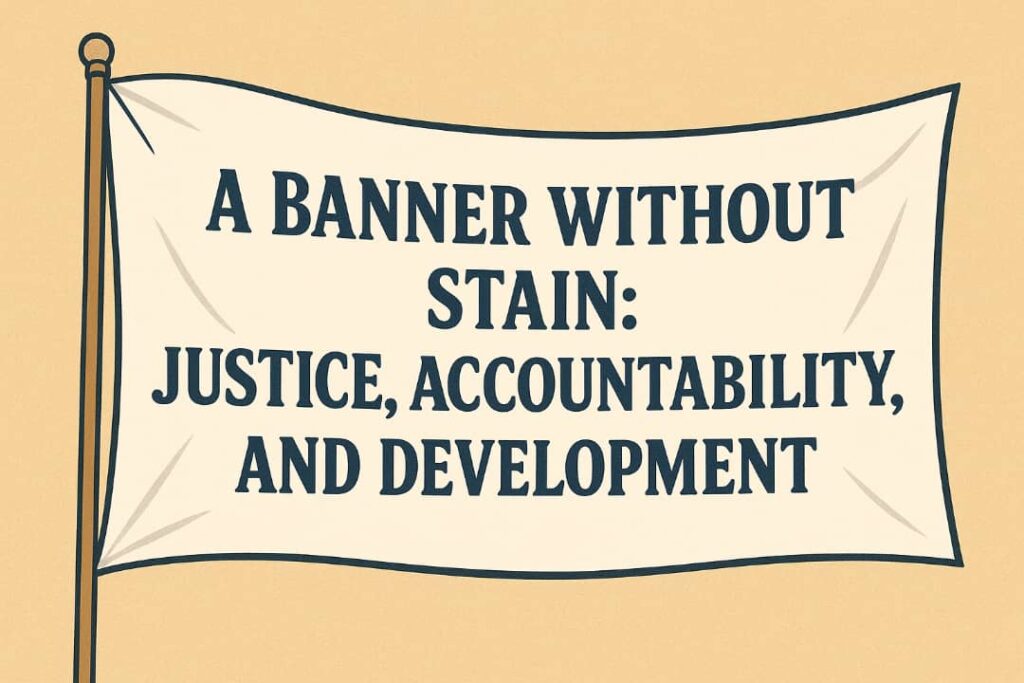


Every nation carries a banner, a symbol of its ideals, its promise, and its moral compass. For Nigeria, that banner is the rule of law, the silent oath that binds citizen and State, rich and poor, ruler and ruled. It is the cloth we swore to defend, woven from the threads of truth, equity, and conscience. Yet today, that banner flutters in the wind of distrust, weighed down by stains of corruption, selective justice, and moral indifference.
To hold that banner without stain is not merely to recite our professional ethics; it is to live them, breathe them, and defend them even when no one is watching. It is to remember that justice is not a career, but a calling.
As lawyers, we stand at the edge of history, where silence has become complicity and integrity has become resistance. The question before us is no longer whether justice matters, but whether we have the courage to keep our banner unstained in a system that rewards compromise. For justice is the soil from which accountability grows, and accountability is the seed from which true development blossoms.
Justice as the Moral Soul of a Nation
Justice is not a luxury; it is the heartbeat of civilization. Without justice, laws become weapons of oppression and courts become stages for performance, not truth. In Nigeria, we often treat justice as a verdict or a pronouncement, but in truth, justice is a living culture, the unseen spirit guiding the relationship between the governed and the government, between leaders and the led, and even between neighbours.
Our justice system mirrors our national conscience. When delays choke our courts, when technicalities bury the truth, when the poor cannot afford representation, justice loses its moral power. Section 17 of the 1999 Constitution speaks of a State founded on social justice, but too often, that ideal remains confined to the page, never touching the lives it was written for.
“Justice delayed is justice denied” has become a chorus of frustration. Each adjournment is not just a date postponed; it is a life suspended in uncertainty. Each unpunished wrong whispers that integrity is optional.
True justice demands both structure and spirit. The structure lies in our laws and institutions, in the Constitution, the Evidence Act, and the Administration of Criminal Justice Act 2015. But the spirit lies in the heart of the advocate who refuses to twist truth, and in the judge who resists pressure and prejudice.
The Nigerian Bar Association, and particularly the Section on Public Interest and Development Law, reminds us that justice is not abstract. It has a face. It is the widow who leaves the courtroom either vindicated or broken. It is the young man acquitted after years of wrongful detention. It is every Nigerian who still believes that truth can triumph over power.
Justice is the soul of a nation, and when that soul darkens, no economy, no reform, no foreign investment can heal the rot.
Accountability as the Price of Trust
Accountability is the bridge between justice and development. Without it, justice becomes theatre, and development becomes a mirage. Accountability ensures that laws are not only written but lived; that leaders are not only elected but answerable; that lawyers are not only called to the Bar but called to conscience.
In our nation, accountability too often begins with fanfare and ends in silence. We set up panels, but bury their reports. We speak of transparency, yet reward secrecy. The erosion of accountability is not only the failure of leadership; it is the quiet surrender of followership.
But the fight for justice begins not in the grand halls of the Supreme Court, but in the small choices made by ordinary lawyers. It begins when a young lawyer refuses to exploit a client’s ignorance, or when a senior counsel refuses to use technicalities to strangle the truth.
For us, accountability begins with our own reflection, how we handle clients’ funds, how we uphold confidentiality, how we carry the dignity of our calling even when no one applauds. Our black robes must never conceal corruption; our eloquence must never mask deceit.
There can be no sustainable development without ethical accountability. When justice is bought, development is borrowed. When the truth is for sale, progress becomes an illusion. Every skyscraper built on injustice will one day collapse under the weight of its own moral weakness.
Nigeria cannot develop on infrastructure alone. It must develop on integrity. Our highways must lead not only to cities but to conscience.
Development as the Harvest of Justice
True development is not the abundance of wealth but the abundance of fairness. It is not measured by GDP but by the dignity of citizens. Development begins where justice is predictable and ends where truth is optional.
Where justice thrives, innovation follows. Where the rule of law reigns, investors trust. Where accountability breathes, nations rise. The connection between justice and development is not poetic coincidence; it is cause and effect.
In the absence of justice, citizens lose faith, and faith is the first currency of development. Without faith in systems, no society can move forward. Development, therefore, is not only economic progress; it is moral progress. It is the collective decision of a people to act fairly even when it is inconvenient.
Section 14(2)(b) of our Constitution declares that the security and welfare of the people shall be the primary purpose of government. Yet welfare without justice is decoration without foundation.
When justice becomes predictable, citizens can plan. When accountability becomes habitual, institutions endure. When both unite, development becomes inevitable. This is the formula we have long ignored, that moral progress must precede material progress.
The Legal Profession as the Guardian of the Banner
As lawyers, we are not mere interpreters of statutes; we are custodians of the nation’s conscience. The courts and the Bar together form the altar upon which the soul of the nation is judged. When lawyers compromise, the nation decays from within. But when lawyers resist corruption, even silently, they renew the hope of the people.
Our banner must therefore remain without stain, not because perfection is possible, but because honour demands it. The glory of our profession lies not in prestige but in purity. Every young lawyer must become a moral insurgent, quietly rebelling against the normalisation of deceit.
Let us revive the sacred pride once attached to this gown, where a lawyer’s word was as strong as his argument, and where truth was not negotiable. Every case we argue, every document we sign, every client we serve becomes part of the moral record of the Bar.
As our courts once affirmed in N.B.A v. Ohioma (2010) 14 N.W.L.R (Pt.1231) 641 at 680, the practice of law is not a casual pursuit but a solemn calling reserved for those who approach it with seriousness of mind and purity of conduct. The judgment reminded us that both the trained and the untrained watch our example, and that every lawyer carries the duty to uphold the noble standards that sustain public confidence in the profession.
The duty of a lawyer extends beyond advocacy; it is a sacred trust to uphold the rule of law and to promote justice in all its forms. Rule 1 of the Rules of Professional Conduct 2023 reminds every practitioner that the honour of our calling rests upon our daily conduct, that we must not only maintain the highest standards of integrity but also avoid any act that diminishes the dignity of the profession. This is the moral compass that guides the Bar, the invisible oath that must remain unstained if justice is to retain its meaning.
Our duty is not to win at all costs, but to ensure that truth wins. The oath we took was not to the powerful, but to the truth itself. To honour that oath is to ensure that the banner of justice remains unstained, unbroken, and unyielding to corruption.
In Rafiu Womiloju & 6 Ors V Mr. Fatai Ogisanyin Anibire & 4 Ors (2010) LCN/4000(SC), Muhammad, JSC observed that the shadow of bias is enough to erode the foundation of justice itself. The same applies to lawyers. When the people no longer believe in our honesty, the entire structure of justice trembles.
Ethical Governance as the Engine of Renewal
Nigeria’s story can still be rewritten. Our institutions can still be redeemed. But the first reform must happen within us, the lawyers who interpret and defend the law. Ethical governance begins not in Aso Rock but in every chamber, every courtroom, every young lawyer who chooses integrity over convenience.
The judiciary cannot be truly independent if the hearts within it are dependent on compromise. Accountability cannot flourish where lawyers are afraid to speak. Development cannot endure where justice serves the powerful.
To raise the banner again, we must rebuild three sacred pillars: integrity, courage, and service.
Integrity demands consistency between private truth and public image.
Courage demands that we speak even when our voices shake.
Service demands that we use the law not merely for profit, but for purpose.
The greatness of any nation does not lie in the wealth of its leaders but in the conscience of its lawyers. When lawyers go silent, injustice grows loud.
A Sacred Reminder of Duty and Conscience
We are the profession upon whose shoulders the rebirth of this nation rests. The question is not whether we will succeed, but whether we will stand for what is right when it costs us.
Will we be remembered as the lawyers who traded truth for convenience, or the ones who stood upright even when bent by pressure? The work of national transformation does not belong only to policymakers; it belongs to those who interpret and enforce the law.
Let us become ambassadors of accountability, not mere preachers of it. Let our chambers become sanctuaries of fairness. Let our pens become instruments of reform. Let us dare to confront broken systems with faith, diligence, and truth.
The battle for Nigeria’s soul will not be fought with weapons, but with principles. Each time a lawyer refuses a bribe, argues with honour, or defends the voiceless, a new Nigeria is born.
The Banner and the Future
Our banner must stand tall again, unstained, unyielding, and unafraid. Let the courts once more become sanctuaries of truth. Let the Bar become the conscience of the nation. Let justice cease to be a privilege for the rich and become the birthright of all.
When future generations look back, may they find that we, the lawyers of this era, did not allow our banner to fall. May they say that when corruption rose like floodwaters, we lifted the flag higher. That when justice was mocked, we defended it with our words, our work, and our will.
Justice, accountability, and development are not distant ideals; they are living responsibilities. Together, they form the moral spine of a nation.
Let us therefore pledge anew, to live by the oath, to uphold the truth, and to guard the banner. For in doing so, we do not merely defend the law; we defend the soul of Nigeria.
Conclusion
In the end, justice is not what we say in court; it is what we live in truth. Accountability is not enforced by fear; it is sustained by conscience. Development is not achieved by policy alone; it is driven by moral purpose.
The destiny of Nigeria rests not in the hands of those who govern, but in the hearts of those who refuse to let the banner fall.
So let us rise, as lawyers, as citizens, as custodians of justice, and hold aloft a banner without stain.
A Banner Without Stain
Poem by F. J. Jude, Esq.
I met a child beneath the bridge,
Her voice was soft, her eyes a ridge.
She said, “My father sleeps in chain,
They said the law forgets the pain.”
Her mother sold her dreams for bread,
Her brother fought where hunger led.
The courthouse shone like holy clay,
But truth was blind and turned away.
I kept her tears inside my chest,
They burned until I made a quest.
I swore that law would learn to feel,
And serve the poor with honest zeal.
I watched the robed ones raise their vows,
Yet bend their hearts to power’s brows.
They built their thrones on borrowed fame,
And called their greed a noble name.
But still a whisper filled the sky,
A voice too just for souls to lie.
It said, “Let justice serve the least,
Or fall like kings who mock the feast.”
Then from the dust the banner rose,
Its white defied the darkest woes.
It bore no mark of clan or chain,
Only the light that breaks the pain.
For justice lives where truth is pure,
Where courage stands and hearts endure.
No stain can stay upon that flame,
When law and love are one in name.
I went again beneath that bridge,
The child now smiled beside the ridge.
She said, “The scales are fair again,
And right has conquered gold and gain.”
The banner flies through sun and rain,
Above a land reborn from pain.
And I, its servant, make my vow:
To guard its truth, to keep it now.
